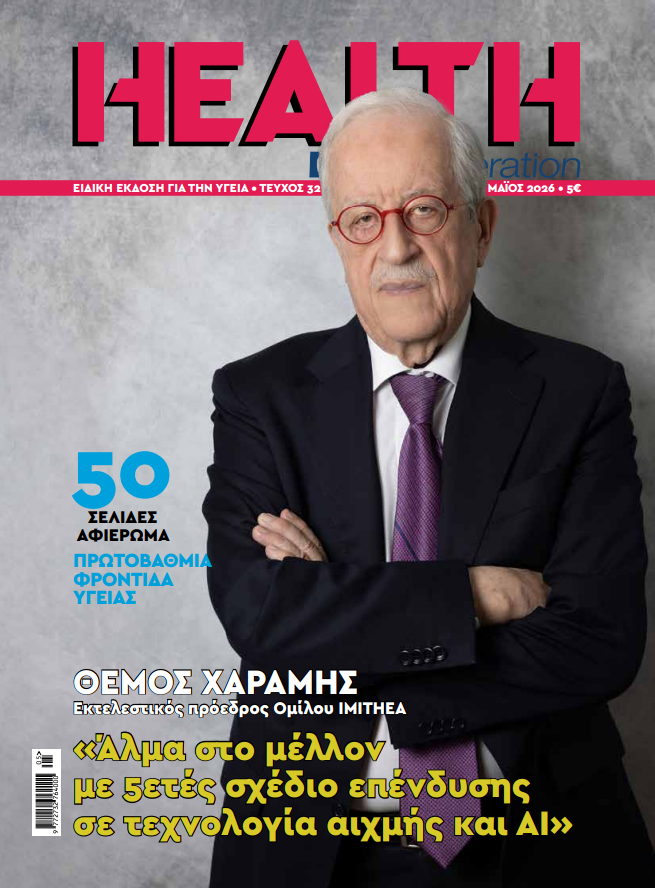
His name is considered synonymous with the modern development of private hospital care in Greece. With a long career spanning every major private healthcare group in Greece, Themos Charamis, Executive Chairman of the IMITHEA Group, outlines the new strategic direction of Henry Dunant Hospital Center and the Group’s other hospitals in Thessaloniki, Kozani and Rhodes, while emphasizing that healthcare is a social good and that private hospitals must always operate with the patient at the center of everything they do.
The challenge in a conversation with Themos Charamis, if you're trying to capture both his personality and his distinctive role in Greece's healthcare sector, is deciding which aspect to explore. You could focus on his career in senior leadership positions at Hygeia Hospital, Athens Medical Center, Onassis Cardiac Surgery Center and Henry Dunant Hospital Center, which is embarking on a new chapter as part of the IMITHEA Group—a career marked by major investment programs and significant milestones. Or you could consider the connection between healthcare, the arts and culture, which he has not only pursued but also actively served. After nearly 35 years as Chairman of the Board of the Art Theatre Theatro Technis, Themos Charamis can talk for hours about his conversations with Karolos Koun, revealing a side of his personality that few people know. Or he can discuss the work of the Greek Surrealists with Professor Manos Stefanidis as he plans yet another art exhibition for Henry Dunant Hospital Center. He may share stories about what Konstantinos Karamanlis told him after each of his checkups, or about his conversations with Melina Mercouri whenever she turned to him for help arranging the hospitalization of actors and other members of the theater and cultural community.
These experiences have led him to firmly believe that “without culture, we can achieve nothing,” since “a society that does not invest in its culture will never care enough to build a high-quality healthcare system.” For this interview, however, we decided to keep the discussion focused on private healthcare and on the plans taking shape at Henry Dunant Hospital Center and across the IMITHEA Group, beginning with how it all started.
Mr Charamis, you have had a long career in healthcare. What would you say was the defining moment in your career that shaped you as an executive?
There have been several milestones marked by decisions and strategic initiatives that proved to be pivotal. If I had to single out one, however, I would say it was when the American hospital chain American Medical International (AMI) took over the management of Hygeia Hospital in 1981 and I joined the organization, first as Finance Director and, from 1985 onward, as Executive Director. At the time, AMI was the world's largest hospital chain, operating 134 hospitals and bringing with it exceptional expertise. After several months of training at hospitals in the United States, I became General Manager of Hygeia Hospital. It was then that, for the first time in Greece, a hospital introduced a comprehensive organizational structure and documented procedures covering all of its operations. At the same time, we implemented organizational and management systems that were unprecedented in Greece. Those early procedures laid the foundation for their subsequent adoption by other private hospitals. Another invaluable experience was my participation in AMI’s international team responsible for developing new hospitals from the ground up in Barcelona, Lausanne, Zurich and London.
When you took over Henry Dunant Hospital Center, it was going through a particularly difficult period. What was the biggest challenge you faced, and which decision do you consider, in retrospect, to have been pivotal to its turnaround?
I took over Henry Dunant Hospital Center in 2017, when it was still recovering from a period of administrative and financial turmoil. My first priority was to rebuild the hospital's credibility with both physicians and patients. At the same time, I had to convince our shareholder that we could turn the Hospital around, both operationally and financially.
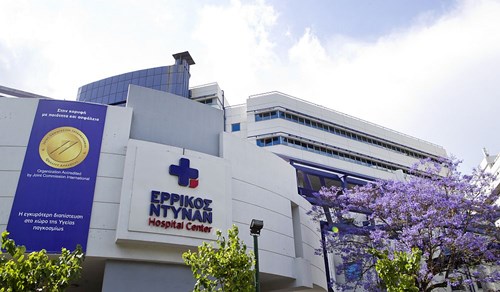
That could only be achieved through a comprehensive reorganization of the Hospital, combined with attracting distinguished physicians alongside our existing medical staff. There was only one way to achieve that: obtaining Joint Commission International (JCI) accreditation for all of the hospital's services—an approach that had already proven successful at Hygeia Hospital in 2010. t was an 18-month effort by the entire staff and medical team, which culminated successfully in Henry Dunant Hospital Center earning the JCI Gold Seal of Approval® in 2020, which it continues to hold today. It has since become a defining part of the hospital's identity.
What was the "secret" behind Henry Dunant Hospital Center's repositioning in the market? What changed in terms of its operations, philosophy and services?
JCI accreditation resulted in a complete reorganization of the hospital at every level, gradually improving the quality of our services while significantly enhancing safety for patients, staff, and physicians. Most importantly, however, it was the united effort of everyone at Henry Dunant Hospital Center that led to this success and marked a new chapter for the hospital. Today, the Hospital is able to to handle any situation with exceptional effectiveness, as demonstrated by our swift response during the pandemic. Henry Dunant Hospital Center is the largest private hospital in Greece and one of the largest in Southeast Europe. The pandemic confirmed that it could take on a broader role and lead efforts in support of the national healthcare response.
In today's highly competitive private healthcare landscape, what is Henry Dunant Hospital Center's main competitive advantage?
Its greatest competitive advantage has always been that it was built from the outset as a hospital to the highest standards. A second, equally important advantage—particularly in such a competitive environment—is that today it delivers high-quality healthcare services at prices at least 20% lower than those of other private hospitals.
You now lead the IMITHEA Group. How does strategic thinking at Group level differ from managing a single hospital?
Since June 2025, Henry Dunant Hospital Center has been part of the IMITHEA Medical Group, which also includes five general hospitals in Thessaloniki, Rhodes and Kozani, as well as a rehabilitation center in Thessaloniki. There's a big difference. We're now developing the strategy for seven hospitals in regions that differ significantly from one another. From Attica and Central and Western Macedonia to the Dodecanese, the Group reaches a population representing more than 60% of Greece's population, creating a new healthcare landscape. The bar has been raised, and we must rise to a new set of challenges.
What is your vision for the IMITHEA Group over the coming years? Are there plans for expansion, new investments or the development of new services?
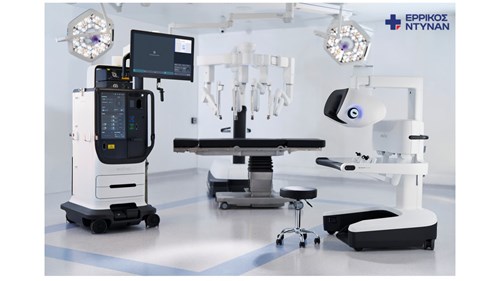
Our vision is to further strengthen the Group and to staff each of our hospitals with outstanding physicians and talented professionals, so that we can continue providing high-quality healthcare services at affordable prices. We are implementing a five-year business plan that includes continuous and substantial investment in state-of-the-art equipment to remain at the forefront of technology, full digitalization of hospital services, adoption of artificial intelligence, and development of new services, as medical science continues to evolve at an extraordinary pace. At the same time, we are establishing new centers of excellence and specialized clinics, while remaining open to strategic partnerships. Through this five-year plan, we also aim to achieve economies of scale, including through a unified procurement system that will enable the reallocation of resources and greater investment in innovation and new technologies.
Based on your experience, how do you assess the current state of private healthcare in Greece? What are its greatest challenges and opportunities?
Private healthcare in Greece is highly advanced, but there is still a need for better organization and, of course, investment in artificial intelligence, which is already here and is essential. In my opinion, the greatest challenges, which are not only for the private sector, are the computerization of all services and medical records, and the standardization of services through international accreditation such as JCI, which enhances both the quality and safety of the services provided. The opportunity lies in forging a stronger partnership with insurance companies, built on a completely new foundation. Perhaps DRGs will provide the solution—if they are eventually introduced and implemented the way they are abroad, rather than à la Greca! We'll see.
What role do partnerships with insurance companies play today, and how do they shape the way private hospitals operate?
Insurance companies are major clients of the private healthcare sector and, as such, play an important role in shaping its operating model. However, I do believe that the time has come to agree on a renewed model of collaboration, one adapted to today's realities that call for a closer, more transparent relationship founded on healthier principles. Regardless of individual business strategies, we should all be on the same side, serving society. Health is a commodity that private hospitals and insurance companies must safeguard. They both know how to do this. First and foremost, there needs to be closer collaboration in developing products. There also needs to be greater flexibility and a fresh approach to developing a wider range of plans that reduce costs for both parties while enhancing the quality of services provided to policyholders. That should be our common objective.
Ultimately, what options does the patient have today in terms of access, quality of care and cost?
It is very encouraging that leading private hospitals have followed the path we set in 2010 at Hygeia Hospital by obtaining Joint Commission International (JCI) accreditation, with Henry Dunant Hospital Center following suit in 2020 and two more hospitals achieving JCI accreditation more recently. JCI accreditation, combined with the hospital's state-of-the-art medical equipment, significantly enhances the quality and comprehensiveness of healthcare services. As a result, patients can meet all their healthcare needs within a single hospital. Private healthcare is expensive everywhere in the world, for obvious reasons, and as a result, it is not accessible to everyone. That is precisely why the National Health System exists. Healthcare services appear more expensive than they actually are because, unfortunately, the government imposes a 24% VAT on what is fundamentally a social good. In most countries, VAT on healthcare ranges from 0% to 6–7%.
What is the biggest truth about the private healthcare sector that is rarely discussed publicly?
In reality, there are no hidden truths or secrets. The sector's weaknesses and needs are well known to everyone. Even those who count on oligopolistic market conditions that distort competition know they have no hidden cards to play.
Interview by Kostis Spyrou for Health Next Generation (Issue 32, June 2026).